


Authors: Dr. Mathias Großklaus, Dr. Vivien Benert, Dr. Torben Klausa
Europe already hosts strong open-source communities and produces a significant share of foundational digital building blocks. Yet the EU often does not capture proportional value, and many promising projects struggle to scale beyond expert users. To unlock Europe’s competitiveness, resilience and democratic capacity, the EU Open Source Strategy should:
→ Treat usability and product development as first-order policy goals, not a “nice-to-have”: open-source solutions often lose at the last mile (UX, onboarding, design, distribution).
→ Shift from short-term innovation funding to lifecycle funding, including long-term maintenance, security response, governance and operations (10 to 20 year horizons for infrastructure-like software).
→ Expand the strategic lens beyond “foundational libraries” to include user-facing, society-shaping digital infrastructures where Europe faces structural dependencies (e.g., communication/discovery and mapping/geo layers).
→ Build one ecosystem, not many silos: enable cross-sector interoperability and compatibility so open-source solutions can reach critical mass.
→ Use EU-level instruments to “open” closed ecosystems where feasible, not to sponsor new projects but to support transitions that increase the overall stock of reusable, auditable software.
→ Create a credible data base on economic value, adoption barriers and value capture, to support Member States and public buyers in prioritisation and sustained investment.
The EU has a strong base of open-source talent, research capacity, and community-driven innovation. Europe contributes substantially to foundational components that underpin modern digital systems. These communities and practices are a strategic asset: they cultivate skills, enable knowledge diffusion, and create the conditions for durable innovation and should be used as such in positioning the EU’s digital (economic) policy vis-à-vis the US and China.
A recurring barrier is that many open-source initiatives are built primarily by and for technically proficient communities. As a result, critical elements for adoption at scale (usability, design, onboarding, documentation for non-experts, localisation, accessibility, product management, distribution) are under-resourced. This gap is not merely cosmetic: it determines whether open source remains a niche or becomes a mainstream option capable of competing with dominant proprietary offerings.
Even widely used open-source components and applications frequently rely on fragile funding structures and volunteer labour. The EU and Member States often fund innovation but underfund maintenance, security hardening, incident response, and long-term operations. In a similar vein, necessary endeavours to transfer and scale working solutions (i.e. software documentation, documentation of organizational practices, standardization / interoperability, transferrable business models, marketing, etc.) are underfunded. Depending on the respective area, sustainability can be provided both by business models and market forces or – where inapplicable – by public funding in the interest of Europe’s democratic societies.
Open-source ecosystems are commonly organised by sector (govtech, smart city, social, health, education, etc.) with limited cross-sector coordination. This fragmentation hampers interoperability and compatibility, reduces reuse, and prevents the formation of critical mass. It also increases duplicated effort and weakens shared maintenance capacity.
Europe often contributes significantly to upstream work, while downstream commercialisation and value capture happen elsewhere. Moreover, in many Member States open source is still perceived as niche or secondary, partly because robust, comparable data on economic impact, adoption drivers and public value is missing. This inhibits sustained political prioritisation and long-term investment decisions.
Open source delivers value not only as a procurement option, but as a governance model for critical digital infrastructure. Its added value is best assessed across economic, security, and democratic dimensions.
For both public and private actors, open source can mitigate lock-in and dependency risks. Importantly, dependency is not only economic. In several “everyday” digital layers, e.g. communication, discovery, mapping, Europe is heavily reliant on a small number of globally dominant platforms. These layers shape market access, information flows, and civic discourse.
Examples of high-dependency layers with high public relevance:
Open source can increase inspectability of critical systems, including algorithmic curation and AI-enabled decision support, when paired with good documentation and governance. This supports democratic oversight, auditing, and contestability – characteristics especially relevant where digital systems influence public debate, access to services, or allocation decisions.
Open source can strengthen cyber resilience by enabling broader review, faster patching, and reduced dependence on a single vendor’s timelines, if maintenance and security processes are funded and professionalised. The assessment should therefore consider not only licensing, but governance maturity, security practices, and maintenance capacity.
Open source lowers barriers for SMEs and public administrations to build on shared components, creating spillovers and enabling European service markets (support, integration, hosting, compliance, training). “Community vitality” itself becomes a competitiveness factor, including talent attraction, learning effects, and faster diffusion of innovation.
Key factors to assess added value (context-dependent):
We recommend a strategy that treats open source as infrastructure policy and ecosystem policy, not only as software funding.
Create dedicated EU support for the “last mile”:
A practical approach is to establish user-facing tracks within EU funding instruments, with evaluation criteria that reward demonstrated adoption and user outcomes, while remaining compatible with open-source community practices.
For software that functions as digital infrastructure, sustainability must be designed in:
This should complement support for foundational components, but broaden it to include user-facing infrastructure where dependencies are societally significant.
EU action can reduce fragmentation by:
Beyond sponsoring new open-source projects, the EU should consider instruments that help transition selected closed-source solutions toward open models where it increases resilience and market contestability:
This is not a blanket approach; it requires clear criteria (public value, dependency reduction, feasibility, security governance).
Public purchasing power can stabilise ecosystems if procurement moves from “pilot projects” to sustainable adoption:
A credible EU-wide data effort would help Member States treat open source as strategic:
Not all high-value open-source infrastructure will sustain itself through market revenue alone. The EU should explore mixed models:
In addition to commonly cited foundational layers, the strategy should explicitly include user-facing digital infrastructures where dependency and public impact are greatest.
These layers shape how people communicate, find information, and navigate the world. They are deeply embedded in daily life and economic activity, yet currently dominated by a small number of global providers.
Tools that function as infrastructure for participation and service delivery (e.g., civic participation platforms, reusable administrative components) should be prioritised because they directly support state capacity and democratic participation.
The EU should broaden the definition of infrastructure beyond networks, compute, and low-level libraries. Many application-level systems (e.g., scheduling/booking infrastructures in health contexts, POI ecosystems, public service portals) are de facto infrastructure and deserve lifecycle-oriented support.
Without discoverability, shared components do not scale. Priorities should include tooling and practices that make open components easier to find, evaluate, integrate, and maintain across sectors.
We do not provide a separate sector-by-sector response, as our submission deliberately focuses on cross-cutting bottlenecks and policy levers that apply horizontally across sectors. The sectoral implications are therefore embedded in our answers to Questions 1 to 4, in particular our argument for prioritising “infrastructure by function”.
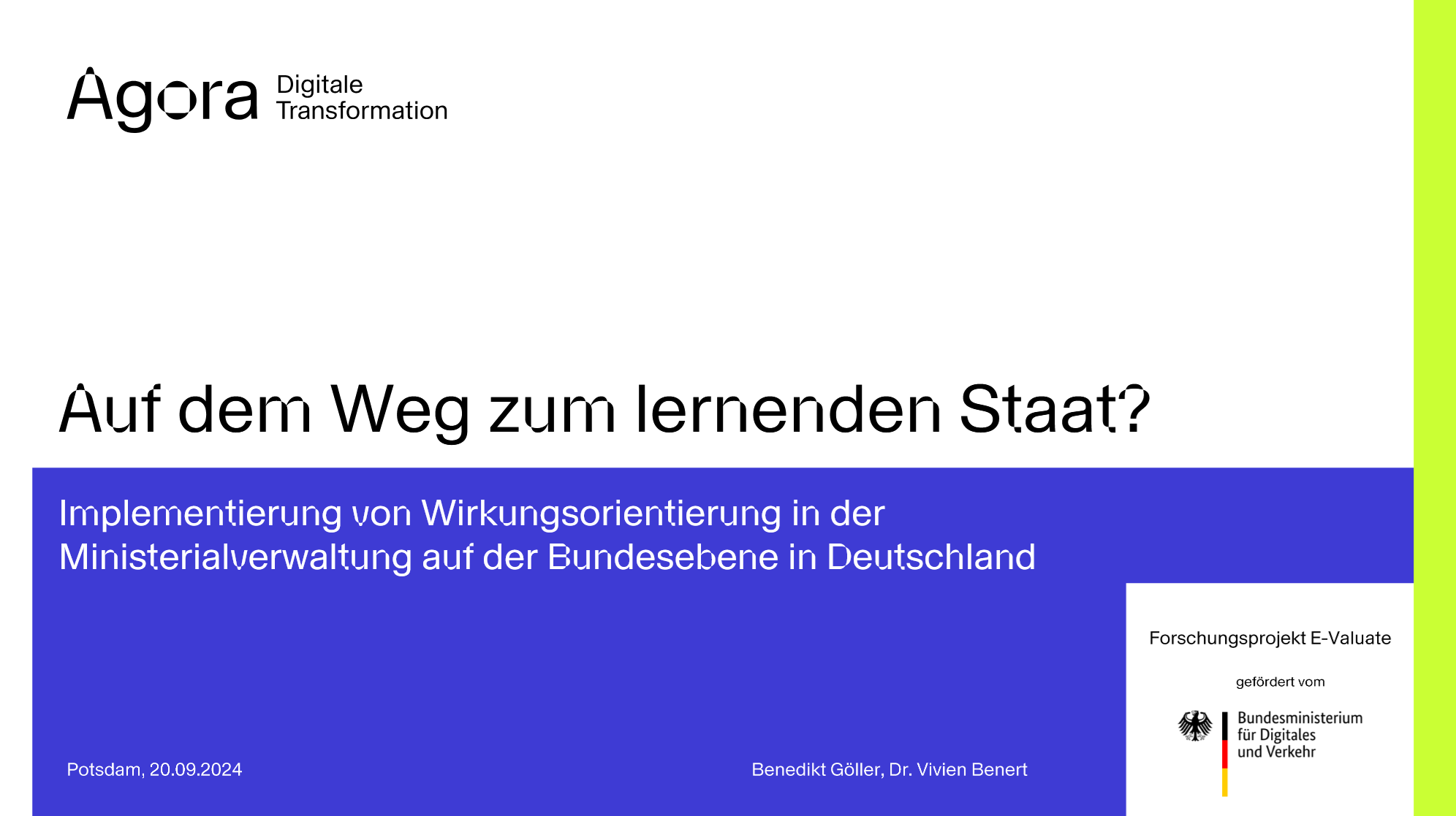
Auf dem Weg zum lernenden Staat? Implementierung von Wirkungsorientierung in der Ministerialverwaltung auf der Bundesebene in Deutschland.
Dr. Vivien Benert
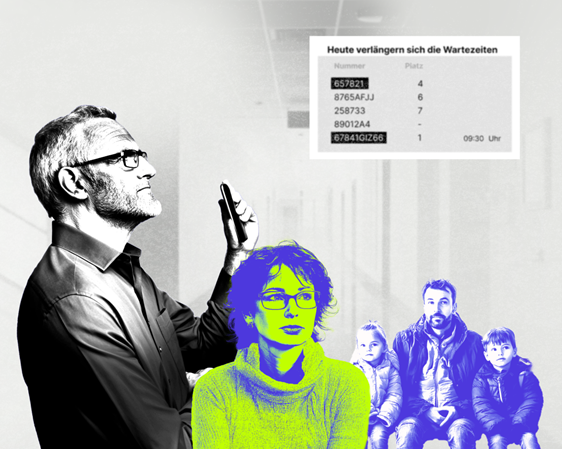
Den digitalen Sozialstaat nutzendenorientiert gestalten.
Dr. Florian Theißing und Jan Snoor Andersen

Staat im Netz. Digitaler Dialog statt Durchsage. Sechs juristische Mythen zu staatlicher Kommunikation im Netz.
Dr. Torben Klausa
Agora Digitale Transformation wird gefördert durch die

Wer sich für unsere Arbeit interessiert, kann sich hier für unseren Newsletter eintragen.